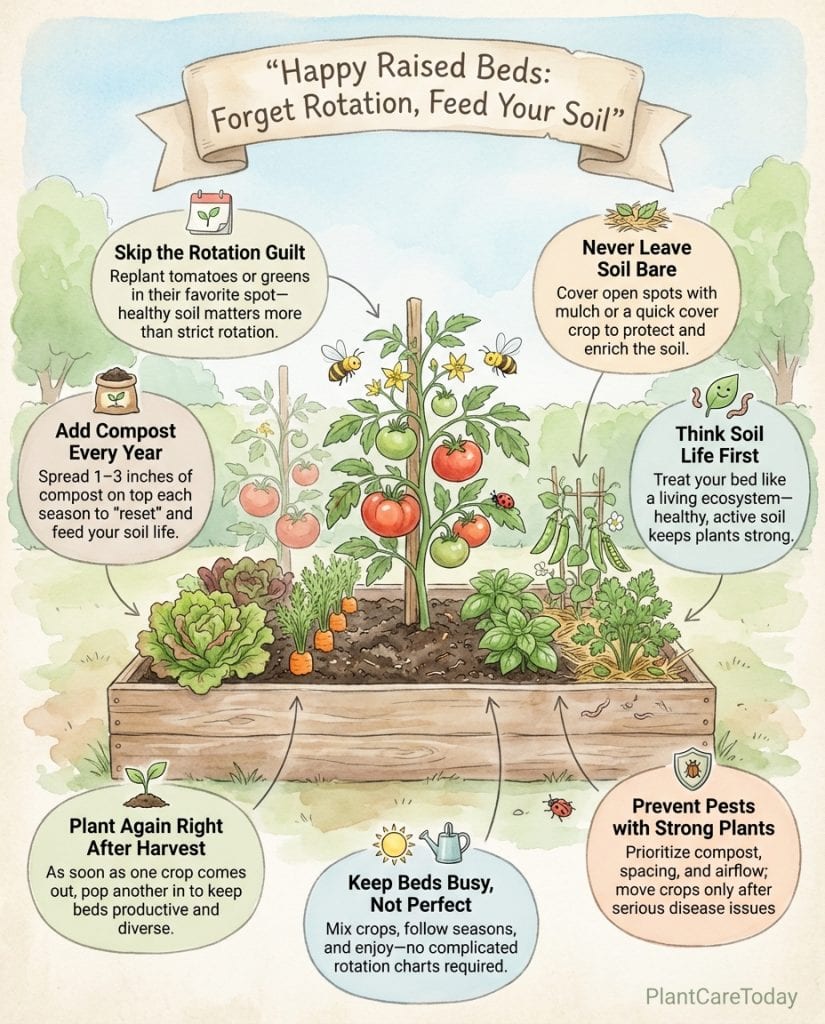
Forget what you’ve heard about crop rotation being essential for raised beds. That outdated rule might be perfect for massive farm fields, but your cozy garden beds play by different rules.
I was surprised to learn that this centuries-old practice isn’t the garden commandment everyone makes it out to be.
If you’ve been stressing over complicated rotation charts or feeling guilty about planting tomatoes in the same spot two years running, you can relax.
Why Farmers Rotate (And Why You Shouldn’t Stress)
Crop rotation emerged in the 16th century and became farming gospel by the 18th century.
But here’s the thing. It was designed for sprawling monoculture farms stretching across hundreds of acres, not your 4×8 raised beds .
Large-scale farmers rotate crops to prevent pest resistance and to manage soil depletion from growing the same crop year after year.
Yet despite all that rotating, they still end up with eroded soil that requires synthetic fertilizers to support growth.
What matters most for your raised beds isn’t moving plants around. It’s how you care for your soil. Think of your garden beds like tiny, well-tended ecosystems rather than mini-farms.
The Ancient Secret of Fallow Ground (Simplified for Modern Gardeners)
Traditional farming once embraced a practice called “fallowing,” in which land was left to rest completely every few years. This principle is even mentioned in the Old Testament, where farmers were instructed to leave fields unplowed every seventh year.
During this rest period, nature rebuilds soil through the decomposition of plant matter and the contributions of animals.
But here’s the best part. You’re already doing this in your raised beds when you add compost. What takes nature a full year, you accomplish in one quick application of rich organic matter.
When you top-dress with compost, you’re essentially giving your soil a treatment that’s far more effective than any rotation schedule.
Why Crop Rotation Is Hard for Small Gardens
Let’s be honest. Traditional crop rotation is complicated for home gardeners. The classic 4-year rotation looks something like this:
• Year 1: Potatoes and cucurbits
• Year 2: Roots and alliums
• Year 3: Legumes and salads
• Year 4: Brassicas
Now imagine trying to track this across multiple small beds while also remembering what grew where three seasons ago. It’s a lot to manage.
Plus, what about those permanent trellises you’ve built? Or that one corner where your snap peas do really well?
Moving everything around annually doesn’t make much practical sense when you’ve found spots where plants thrive.
3 Better Alternatives That Actually Work
Instead of worrying about rotation charts, focus on these three soil-building techniques that deliver great results with less hassle:
1. Embrace Succession Planting Like a Pro
The real trick is that succession planting mimics nature far better than rigid rotation schedules. Plants in natural settings change throughout the seasons, with different species thriving at different times.
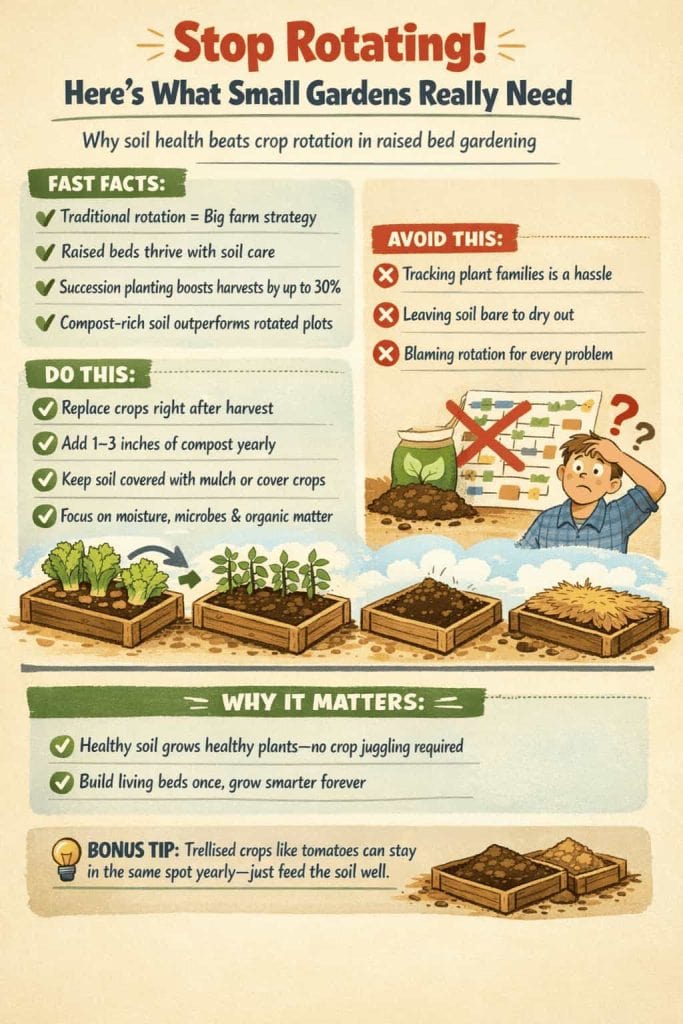
In your garden, this means immediately replacing one harvested crop with another. Potatoes followed by leeks. Broad beans followed by carrots. This natural cycling adds diversity to your soil without the headache of tracking plant families year after year.
According to research from university extension offices, this continuous planting approach can increase your garden’s yearly yield by up to 30% while naturally breaking pest cycles .
2. Feed Your Soil Generously
Your soil is a living thing that thrives on organic matter. Add at least 1 inch of compost annually – 3 inches will really transform your garden. This simple practice creates soil so rich in nutrients and beneficial microorganisms that plant family rotation becomes largely unnecessary.
The difference between new and experienced gardeners often lies in their commitment to soil health. When you build healthy, living soil, plants do well regardless of what grew there before.
3. Never Leave Soil Naked
Your garden beds don’t want to be exposed. Nature doesn’t like bare soil – that’s why weeds quickly colonize empty spaces.
Keep your soil protected with either:
• Mulch: A 2-3 inch layer that mimics forest floor leaf litter
• Cover crops: Fast-growing “green manures” that shade soil while adding nutrients
This protective layer prevents erosion, maintains moisture, and creates habitat for beneficial soil organisms. It essentially does what crop rotation attempts to do, but more effectively.
But What About Pests and Diseases?
Let’s address the concern: Won’t skipping rotation lead to pest problems?
Not necessarily. Studies suggest that weather patterns and plant health have a far greater impact on disease prevalence than planting location.
For example, tomato and potato blight are more influenced by humidity levels and timing than by whether you’ve rotated crops.
That said, if you experienced severe disease issues with a specific crop, moving it to another location isn’t a bad idea. But rather than following rigid rotation rules, focus on:
• Growing vigorous, healthy plants that naturally resist pests
• Improving airflow between plants
• Using physical barriers like row covers for vulnerable crops
• Building soil that supports beneficial organisms
I’ve grown tomatoes in the same raised bed for 4 straight years, with yields increasing each season. The key is good soil care.
The Proof Is In The Harvest
Renowned garden expert Charles Dowding has conducted side-by-side experiments for years, comparing traditional methods with no-dig approaches that don’t rely on crop rotation.
The results? Plants grown in well-maintained, compost-rich beds consistently outperform those in rotated plots.
Your garden will speak for itself. If plants are struggling, look first at environmental factors, soil moisture, and nutrient levels – not your rotation schedule.
Freedom From Rotation Rules
Gardening should bring joy, not stress over complicated crop rotation schedules. By focusing on succession planting, generous compost application, and keeping soil covered, you’ll create a flourishing raised bed garden that defies conventional wisdom.
So go ahead. Plant those tomatoes in their favorite sunny corner again. Your garden won’t just survive without rotation. It will thrive.