When it comes to feeding hydrangeas, there are lots of mixed signals about when and how to fertilize.
One of the common questions I get is whether hydrangea plants require specific fertilization schedules and when to fertilize them.
Hydrangeas, on the whole, are pretty tough plants. They don’t necessarily need to be fertilized to grow well, but there’s the temptation to fertilize anyway.
How you feed hydrangeas can make a difference in their growth and flowering habits, though, and it may even affect their color, at least for bigleaf hydrangeas (Hydrangea macrophylla).
So, let’s clarify how and when to fertilize hydrangeas.

Do Hydrangeas Need Fertilizer?
Hydrangeas typically grow and bloom perfectly well without any fertilizer in soils rich in organic material.
This is often the case in their natural habitat or in well-established ornamental beds, where leaves and other plant matter decompose and enrich the soil.
For example, if your soil has been enriched with compost, you likely won’t need to feed your hydrangeas.
In nutrient-deficient soils or those with little organic matter, such as sandy or heavy clay soils, feeding your plants can give them the extra boost they need to grow vigorously and bloom to their full potential.
Nutrient deficiency manifests as yellow or brown leaves, reduced leaf growth, and fewer blooms. Keep an eye out for these signs.

When to Fertilize Hydrangeas
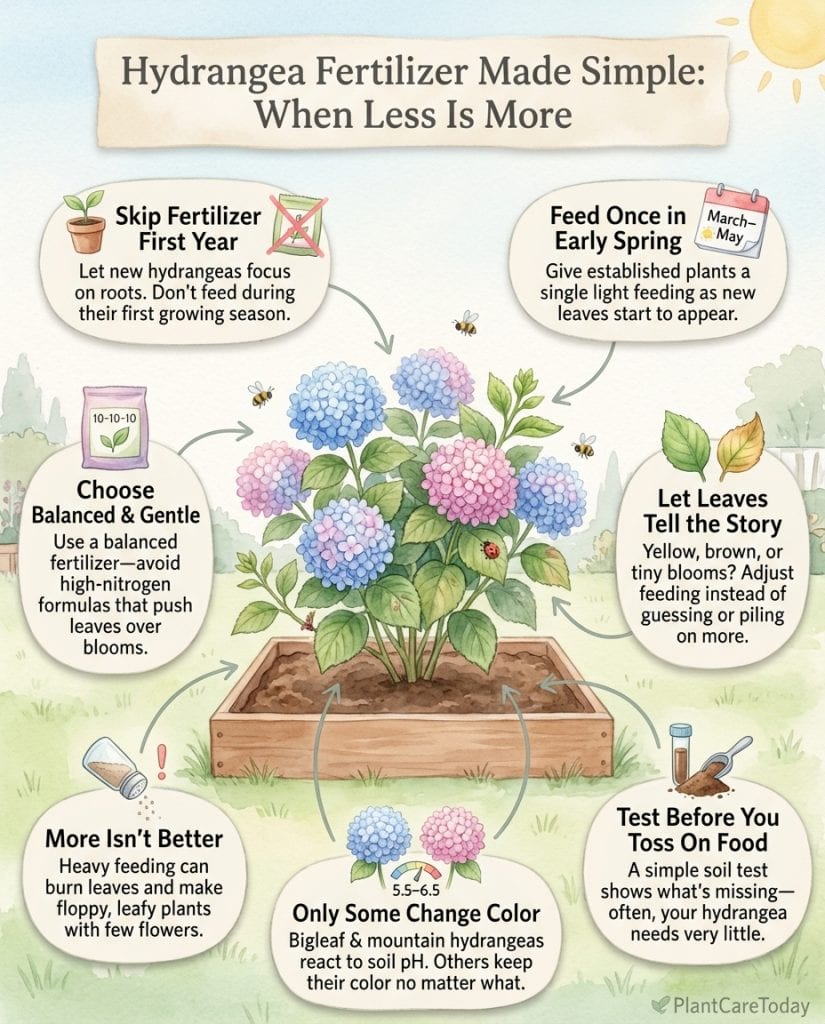
Timing can vary depending on your plants’ age. I feed only once for most established hydrangeas, in late winter or early spring.
That’s when the plant is getting ready to produce new growth, so applying fertilizer at this time helps fuel that growth.
In the south, that might be as early as March, while in cooler climates, April or May might be more appropriate.
You shouldn’t feed newly planted hydrangeas at all during their first year.
The fertilizer in newly amended soil and any plant food you used at planting time can burn new roots. Wait until your shrubs have gone through one full growing season before fertilizing them.
How to Fertilize Hydrangeas
When you feed hydrangeas, use the right formula. I typically use a general balanced fertilizer with all three major plant nutrients: nitrogen, phosphorus, and potassium (abbreviated NPK).

These are some ideal ratios: 10-10-10, 12-4-8, or 15-30-15. For organic fertilizers, blood meal (for nitrogen), bone meal (for phosphorus), and wood ashes (for potassium) are good choices.
You might be tempted to use a bloom-boosting fertilizer high in phosphorus (middle number), but be aware that many soils already contain adequate phosphorus.
Avoid fertilizers high in nitrogen (first number), especially if you have one of those luscious bigleaf hydrangeas with the striking blue or pink mophead or lacecap flowers.
Nitrogen encourages leafy growth but fewer flowers. It may also weaken stems, making the plant unable to bear the weight of those big, showy blooms.
How to Change Hydrangea Colors
Bigleaf and mountain hydrangeas can change color depending on soil pH. The flowers will be blue in acidic soils with a pH below 5.5, while alkaline soils with a pH above 6.5 will produce pink flowers.
If you’re trying to manipulate flower color to get blue flowers, aluminum sulfate can help acidify the soil. You can use dolomitic lime to raise the soil pH for pink flowers.

But be careful: soil amendments (such as lime or aluminum sulfate) that significantly change soil pH can also disrupt beneficial soil life or reduce nutrient availability. Use them sparingly.
Only bigleaf hydrangeas and mountain hydrangeas have flowers that change color in response to soil chemistry.
Other hydrangea types, such as oakleaf, panicle, climbing, and smooth hydrangeas, do not change flower color with changes in soil pH.
White hydrangea flowers are not affected by soil pH.
Signs of Hydrangea Distress
Your hydrangea may show signs that it’s not getting enough or getting too much fertilizer, including:
- Yellow or brown leaves (could indicate a nutrient deficiency)
- Stunted growth or few flowers (might need more phosphorus)
- Wilting despite adequate water (possible nutrient imbalance)
- Excessive leafy growth with few flowers (too much nitrogen)
- Brown leaf edges (fertilizer burn from over-application)

Monitor these signals to adjust your care routine accordingly.
Testing Your Soil
Before investing in any fertilizer or altering your soil, consider doing a soil test through your local extension service.
For a small fee, they will tell you exactly what nutrients your soil needs, if any, and will recommend specific amendments.
A shocking 67% of home gardeners have never tested their soil, yet it’s the single most important step before making any soil amendments!
You may discover that your soil is already rich in certain nutrients and doesn’t need additional fertilizer.
The Bottom Line on Feeding Hydrangeas
The game-changer for your hydrangeas isn’t what you think; it’s often less about adding fertilizer and more about understanding what your specific plants actually need.
Your hydrangea is trying to tell you something important through its growth patterns and appearance.

Remember these key points:
- Most established hydrangeas need just one feeding per year in early spring
- New plants shouldn’t be fertilized in their first year
- A balanced fertilizer works best for most hydrangeas
- Watch for signs of nutrient deficiency or excess
- Consider a soil test before making assumptions about what your soil needs
I am not shocked to learn that many hydrangea problems come from over-fertilizing rather than under-fertilizing. Sometimes the best care is the simplest care!