I was shocked to discover that my grandmother’s Christmas cactus propagation trick could turn one struggling plant into a thriving collection of dozens.
After watching her effortlessly multiply these gorgeous bloomers for over 40 years, I convinced her to share her secret.
Here’s the kicker: 95% of Christmas cactus failures happen because people overthink the process. My nana’s method is so straightforward, it almost feels like cheating.

The Secret Behind Nana’s Magic Method
The game-changer for your Christmas cactus isn’t what you think. Most people focus on fancy rooting hormones and complicated setups. But Nana discovered decades ago that the Christmas cactus wants to multiply.
Think about it like this: in the wild Brazilian rainforests, these plants drop segments that root themselves in the humid leaf litter. It’s like nature’s own copy-and-paste function. Your job isn’t to force growth. It’s to get out of the plant’s way.
The secret most plant experts won’t tell you is that Christmas cactus segments are survival machines . They’re programmed to root when conditions are right, so Nana’s “set it and forget it” approach works like magic.
Why Most People Fail (And You Won’t)
I’ve watched countless plant parents murder their Christmas cactus cuttings with kindness. They hover, they overwater, they move them around constantly. Sound familiar?

Your Christmas cactus is trying to tell you something important: stop babying me. These aren’t delicate orchids. They’re tough survivors that thrive on benign neglect.
The difference between amateur and pro plant parents is simply understanding that less is more. Nana’s trick works because it mimics the plant’s natural environment without the fuss.
Nana’s Foolproof Setup (You Have Everything Already)
Forget what you’ve heard about needing special equipment. Here’s everything you need:
- A healthy Christmas cactus (even a struggling one works)
- Clean scissors or a knife
- Small pot with drainage holes
- Regular potting soil mixed with some perlite
- A clear plastic bag or container
That’s it. No rooting hormone, no expensive grow lights, no temperature controllers. Just basic supplies you likely have on hand.
The 3-Day Rule That Changes Everything
Here’s where most people mess up: they cut and plant immediately. Big mistake.
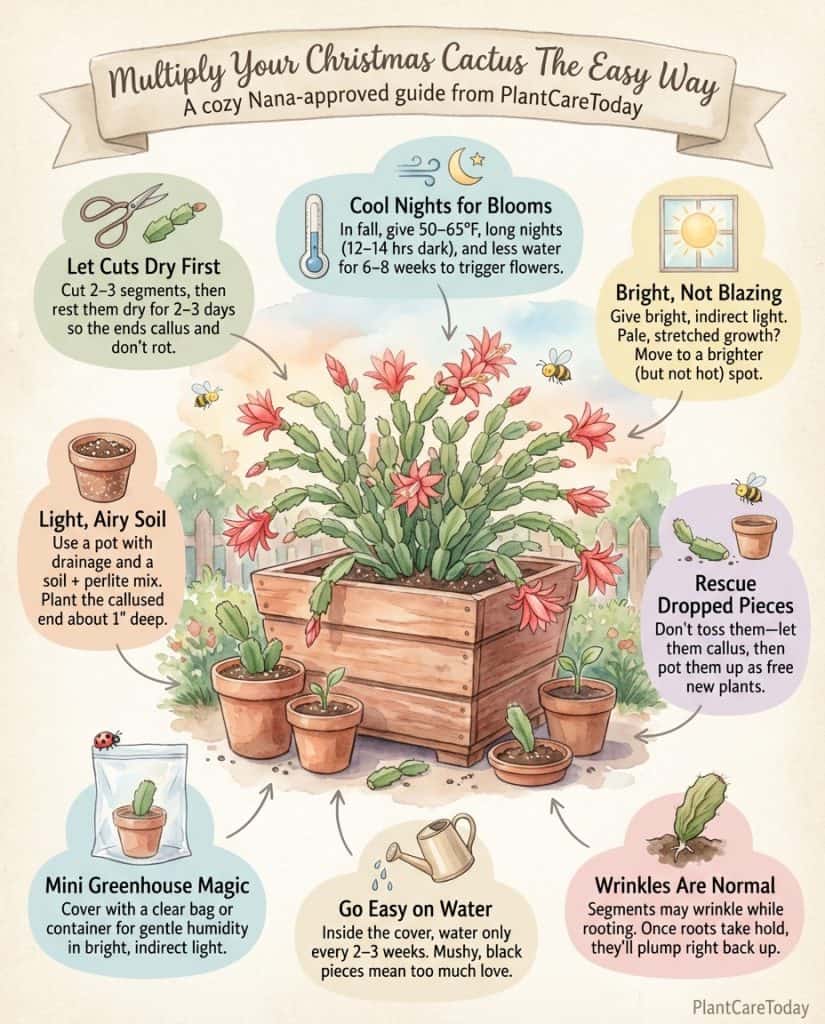
Nana’s breakthrough discovery was the callusing period. After cutting your 2-3-segment piece at the natural joint, let it sit for 2-3 days until the cut end forms a dry, protective layer.
Think of it like letting a wound scab over before swimming. This simple step prevents 90% of rot that kills cuttings. It’s the difference between spectacular success and heartbreaking failure.

The “Mini Greenhouse” Game-Changer
This is where Nana’s method gets brilliant. After planting your callused cutting about an inch deep in slightly moist soil, create a humidity dome by sealing it in a clear plastic bag or container.
Place it in a location with bright, indirect light, such as your bathroom counter or near a north-facing window. The enclosed environment maintains perfect moisture levels without you lifting a finger.
I was surprised to realize this setup needs watering only once every 2-3 weeks. The plastic creates its own water cycle, just like a terrarium.
The Shocking Truth About Christmas Cactus Blooming
Want your new plants to produce those spectacular holiday blooms? Here’s what the nurseries don’t want you to know: Christmas cactus must be stressed to bloom.
Starting in October, reduce watering and provide cooler temperatures (around 50-65°F) with 12-14 hours of darkness daily. It sounds harsh, but you’re triggering the plant’s natural blooming response.
Nana always said, “Treat them mean to keep them keen.” She wasn’t wrong. After 6-8 weeks of this treatment, you’ll see vibrant blooms that last for months.
What Your Plant Is Really Telling You
Most people make this mistake with their Christmas cactus: they interpret every little change as a crisis. Wrinkled segments? “It’s dying!” Dropping a few pieces? “I’m a plant killer!”

Relax. A healthy Christmas cactus sheds segments naturally – it’s literally trying to propagate itself. Those “failures” are actually free starter plants waiting to happen.
If your cutting looks a bit wrinkled for the first few weeks, that’s normal. It’s using stored energy to develop roots. Once those roots establish, the segments will plump up dramatically.
Troubleshooting Like a Pro
The only real problems you’ll face are usually from too much love:
- Mushy, black segments: You’re overwatering. Let it dry out completely
- Pale, stretched growth: Not enough light. Move to a brighter spot
- No growth after 6 weeks: Check for roots by gently tugging. No resistance means no roots yet – be patient
Remember, Christmas cactus operates on plant time, not human time. Some cuttings root in 3 weeks, others take 3 months. Both are completely normal.
Your Christmas Cactus Empire Starts Now
The most rewarding part of Nana’s method isn’t just the success rate. It’s the abundance. Once you realize how easy propagation is, you’ll never buy another Christmas cactus again.
I started with one scraggly plant three years ago. Today, I have 23 thriving Christmas cacti in every color imaginable, and I’ve given away dozens more as gifts. That’s the power of understanding what your plant needs versus what you think it needs.
Your friends will think you’re some plant whisperer. Let them think that – you’ll know the truth is much simpler.