Let me guess – your petunias started out as gorgeous, flower-covered superstars, but now they’re leggy, sparse, and honestly… a bit embarrassing? You’re not alone.
The secret most plant experts won’t tell you is that 80% of petunia problems come down to one simple thing: you’re pruning them all wrong (or, gasp, not pruning them at all).

The Brutal Truth About Your Struggling Petunias
Forget what you’ve heard about petunias being “low-maintenance.” These colorful divas demand proper pruning to reach their full potential.
Without it, they transform from compact flowering machines into lanky, bloom-starved stems stretching desperately for attention.
Most people make this mistake with their petunias: they feel guilty about “hurting” the plant by cutting it back. But here’s the reality check. Your petunia is literally begging for a haircut. It’s like refusing to trim your hair and wondering why you have split ends!
The Game-Changing Pruning Tools You Actually Need
Before you start snipping, let’s get something straight. Those rusty kitchen scissors aren’t doing your plants any favors. Your petunias deserve better!
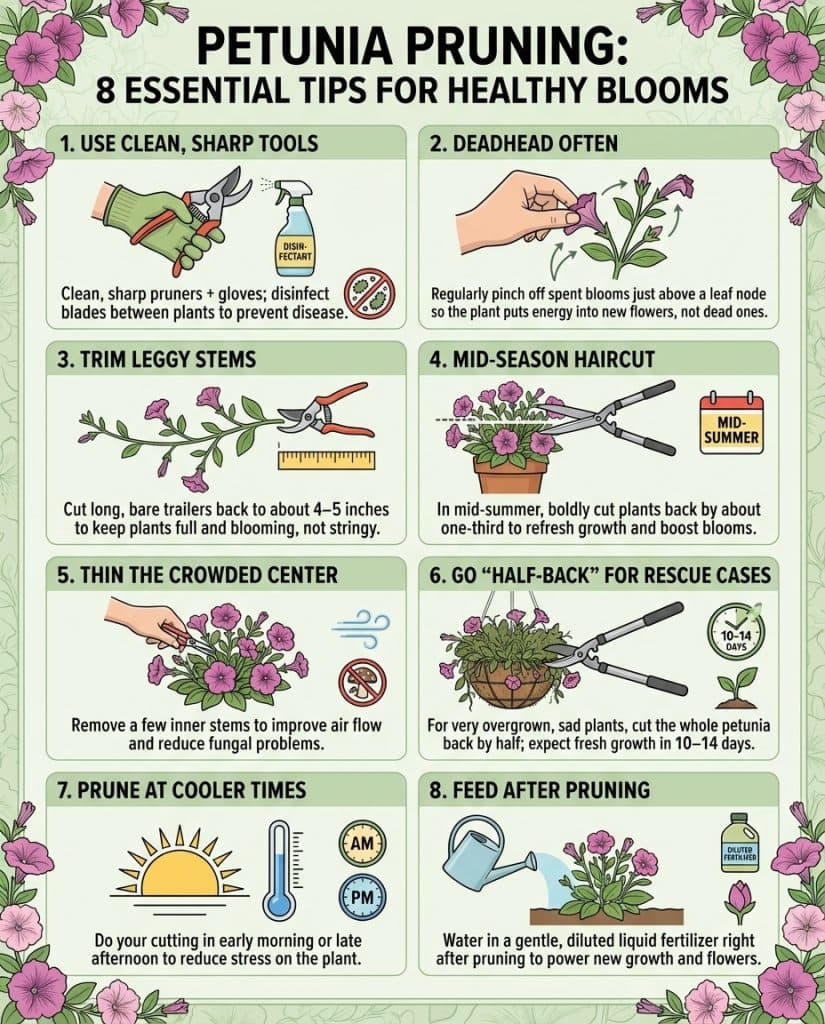
- Sharp, clean pruning shears: Dull blades crush stems rather than cleanly cutting them (ouch!)
- Gardening gloves: Because sticky petunia stems make for messy hands
- Disinfectant solution: Your pruners could be a disease highway between plants
- Collection container: For gathering debris that could harbor pests
I was shocked to discover that tools carrying pathogens can infect up to a dozen plants before symptoms even appear. Take the extra 30 seconds to clean your tools. Your petunias will thank you.

Timing Is Everything: When to Make the Cut
Think of petunia pruning like getting a coffee. There’s a right time, and that time is NOT high noon. Early morning or late afternoon pruning dramatically reduces plant stress.
The game-changer for your petunias isn’t what you think… It’s actually a mid-season “haircut” that can completely transform leggy plants. Around mid-July, when your petunias start looking stretched out and sad, be brave and cut them back by about one-third.
This shocking reset is like sending your plants to Petunia Boot Camp. They’ll come back stronger and more floriferous than ever!
The 5-Step Pruning Method That Will Revive Your Petunias
Ready to rescue those struggling blooms? Here’s the no-fail system used by professional gardeners:
- Deadhead relentlessly: Remove spent blooms by pinching stems just above a leaf node. Did you know a single petunia can waste up to 30% of its energy on maintaining dead flowers? Cut them loose!
- Cut back the leggy trailers: Those long, sparse stems with few flowers? They’re literally dragging your plant down. Trim them back to about 4-5 inches from the main plant.
- Thin the crowded center: Your petunia needs to breathe! Remove a few stems from the middle to improve air circulation and reduce fungal disease risk by up to 60%.
- Shape for symmetry: Step back and look at your plant. Is it lopsided? Even out the overall shape for balanced growth and that professional “garden tour” look.
- Feed after pruning: Give your newly pruned plant a diluted liquid fertilizer to kickstart vibrant regrowth.

The “Half-Back” Secret for Desperate Cases
Let’s have a heart-to-heart. Is your petunia so leggy that it resembles a spider plant more than a flowering annual? Time for dramatic intervention. The difference between amateur and pro plant parents is simply the willingness to make tough cuts.
For severely overgrown petunias, use the “half-back” technique: cut the entire plant back by half its size in one go. Sound terrifying? It is! But within 10-14 days, your petunia will explode with new growth and bloom again in about three weeks.
(Just between us, I once cut a hanging basket of petunias back so severely my husband thought I’d killed them. Two weeks later, he was asking what my “plant revival secret” was!)
Warning Signs Your Pruning Technique Is All Wrong
Your petunia is trying to tell you something important if you notice these red flags after pruning:
- Yellow leaves appearing: You’ve either cut too much at once or damaged healthy tissue
- No new growth after 2 weeks: Your cuts may have been too aggressive or made during peak heat
- Stems turning black at cut points: Your tools might be dirty and spreading disease
- Plants looking sparse but still leggy: You’re being too timid with your pruning
Transform Your Petunias from Mediocre to Magnificent
The stunning truth? With proper pruning alone, you can double the bloom count on your petunias. Add in regular fertilizing and adequate watering, and you’ll have the flourishing flower display that makes neighbors stop and stare.

Remember: petunias aren’t delicate snowflakes. They’re flowering machines that perform best when pruned regularly and decisively.
Be bold with those pruners! Your reward will be vibrant, compact plants that bloom continuously, rather than sparse, leggy disappointments.
Now go forth and prune with confidence. Your petunias are counting on you!