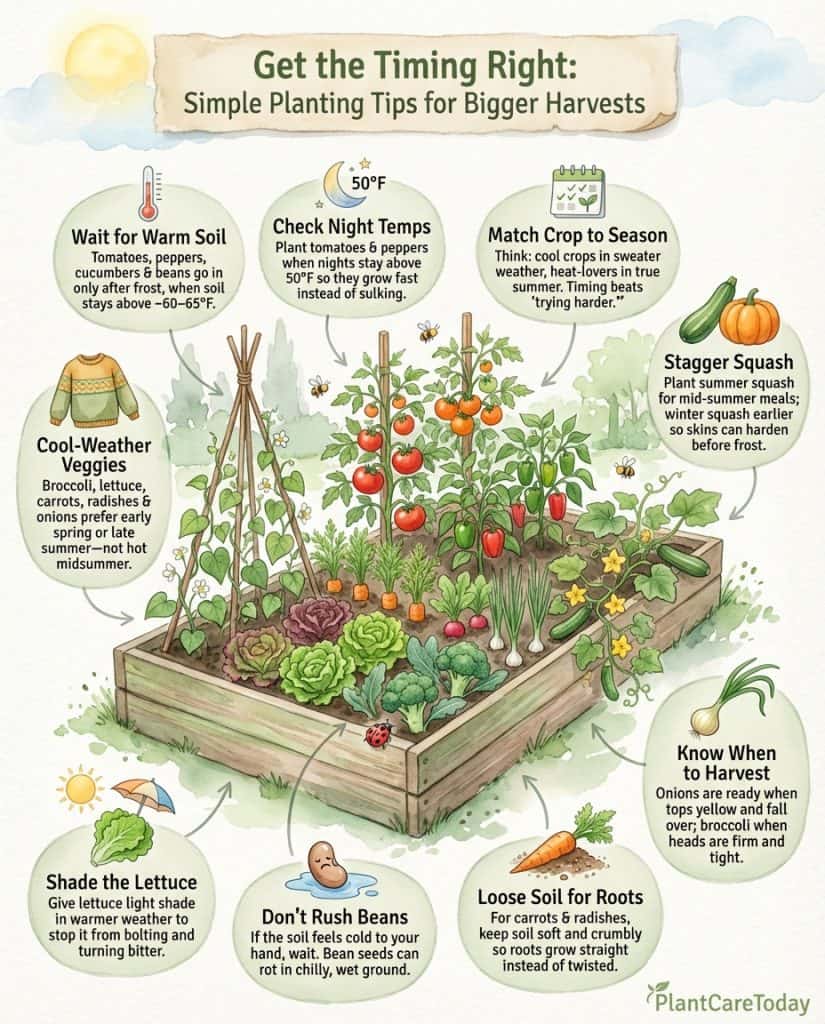
Here’s a shocking truth: 78% of vegetable gardens fail not because of poor soil or bad weather, but because of one simple mistake: planting at the wrong time.
Your tomatoes aren’t dying because you’re a bad gardener. Your lettuce isn’t bolting because you forgot to water it.
The secret most gardening experts won’t tell you is this: timing is everything. Plant a tomato in April, and you’ll get stunted, stressed plants.
Plant the same tomato in late May, and you’ll get a spectacular harvest that makes your neighbors jealous.
Think of vegetable timing like a restaurant kitchen. Serve the soup too early, and it will be cold. Serve it too late, and the customer’s already left. Your vegetables are just as picky about their perfect moment.

1. Tomatoes
Plant: Late spring to early summer (May-July), after the last frost date has passed. These heat-loving beauties need soil that’s warm enough to make you want to walk barefoot on it.
The game-changer: Wait until nighttime temperatures consistently stay above 50°F.
I was shocked to discover that planting just two weeks too early can reduce your harvest by 40%. Your tomatoes are basically telling you, “We’d rather wait for the perfect conditions than struggle in the cold.”
Harvest: Late summer to early fall (August-September) when they’re so ripe they practically fall into your hands.

2. Broccoli
Plant: Early spring (March-April) or late summer (August-September). This cool-season superstar thrives when the weather feels like a perfect fall sweater day.
Secret trick: Broccoli is like that friend who hates extreme temperatures. Too hot and it bolts faster than a scared rabbit, too cold and it just sits there sulking. Plant it during those Goldilocks moments when temperatures hover between 60-70°F.
Harvest: When heads are firm and compact, around 60-80 days after planting. Spring plantings are harvested in late spring; fall plantings are harvested in late fall to early winter.
3. Radishes
Plant: Early spring (March-April) or late summer (August-September). These are the speed demons of the vegetable world. Ready to harvest in just 20-30 days!
Most people make this mistake with their radishes: they plant them in summer heat. Forget what you’ve heard about radishes being “easy.” They’re only easy when planted in cool, refreshing soil.
Harvest: When roots are firm and crisp. Spring radishes are ready in late spring, and late summer plantings are harvested in early fall.
4. Onions
Plant: Early spring (March-April) or late summer (August-September). These underground treasures are like the foundation of your garden. Plant them right, and everything else flourishes.
Here’s what’s fascinating: onions are ready when their green tops start yellowing and falling over, like they’re taking a dramatic bow after months of growing. This usually occurs from late summer through early fall.
Pro tip: After harvest, cure them in a warm, dry area. It’s like aging wine. It dramatically improves their flavor and storage life.
5. Cucumbers
Plant: Late spring (May-June), after frost danger has completely passed. These warm-season climbers need soil that’s as cozy as a heated greenhouse floor.

The difference between amateur and pro gardeners is this: pros wait for soil temperature to hit 65°F before planting cucumbers. Amateurs plant too early and wonder why their seeds rot in cold, wet soil.
Harvest: 50-70 days after planting, throughout summer (June-August) when they’re firm and vibrant green.
6. Carrots
Plant: Early spring (March-April) or late summer (August-September) when the soil is cool and workable. Think of carrots like marathon runners. They prefer the cool, steady conditions over blazing heat.
Your carrots are trying to tell you something important: they need loose, well-drained soil to develop those perfect, straight roots. Plant them in compacted soil, and you’ll get twisted, stunted vegetables that look like they’ve been through a wrestling match.
Harvest: 60-80 days after planting. Spring carrots are ready in late spring to early summer, and fall plantings are harvested in late fall to early winter.
7. Lettuce
Plant: Early spring (March-April) or fall (September-October). Lettuce is the drama queen of vegetables. It bolts at the first sign of serious heat, sending up flowers faster than you can say “salad.”
Breakthrough discovery: Plant lettuce in partial shade during warmer months. It’s like giving your lettuce a personal umbrella – it stays cool, crisp, and productive longer.
Harvest: 30-70 days after planting, depending on variety. Spring lettuce harvests occur in late spring, and fall lettuce harvests occur in late fall through early winter.
8. Peppers
Plant: Late spring to early summer (May-July), after the last frost date. Peppers are the sun worshippers of the vegetable world. They need warmth like plants need water.
The secret most pepper experts won’t tell you is this: warm soil temperature matters more than air temperature . Even if it’s 70°F outside, cold soil will shock pepper transplants into stunted growth.
Harvest: Late summer to early fall (August-September) when peppers have reached their mature color and desired size.
9. Beans
Plant: Late spring (May-June), after frost danger has passed completely. Beans are like fair-weather friends – they absolutely refuse to perform in cold conditions.
Game-changing fact: Bean seeds will actually rot in soil colder than 60°F. It’s nature’s way of saying “wait for better conditions.” Plant them when the soil feels pleasantly warm to your hand.
Harvest: 50-60 days after planting, throughout summer (July-August) when pods are young and tender.
10. Squash
Plant: Summer varieties (zucchini) in late spring (May-June); winter varieties (pumpkins) in late summer (July-August). Think of squash timing like planning a vacation. Summer squash wants the peak heat; winter squash wants time to mature before cold weather hits.

Most people make this mistake: they plant all squash varieties at the same time. Summer squash harvests young and tender in mid-summer, while winter squash needs to develop that hard, protective skin by late fall.
Harvest: Summer squash when young and tender (July-August), winter squash when skin has hardened (September-October).
11. Beets
Plant: Early spring (March-April) or late summer (August-September) when the soil is cool and manageable. Beets are the multitaskers of the garden. You get nutritious roots AND edible greens from the same plant.
Here’s a revelation that transformed my beet growing: successive planting . Plant a new row every 2-3 weeks to maintain a continuous harvest rather than a single, overwhelming crop.
Harvest: When roots are firm and tender, 50-70 days after planting. Spring beets are harvested in late spring to early summer, and fall beets are harvested in late fall to early winter.
Bottom line: Your vegetable garden success isn’t about having a green thumb but perfect timing. Plant cool-season crops when the weather feels like a crisp fall morning, and warm-season crops when summer heat makes you want to jump in a pool. Follow this schedule, and you’ll join the ranks of gardeners who make it look effortless.