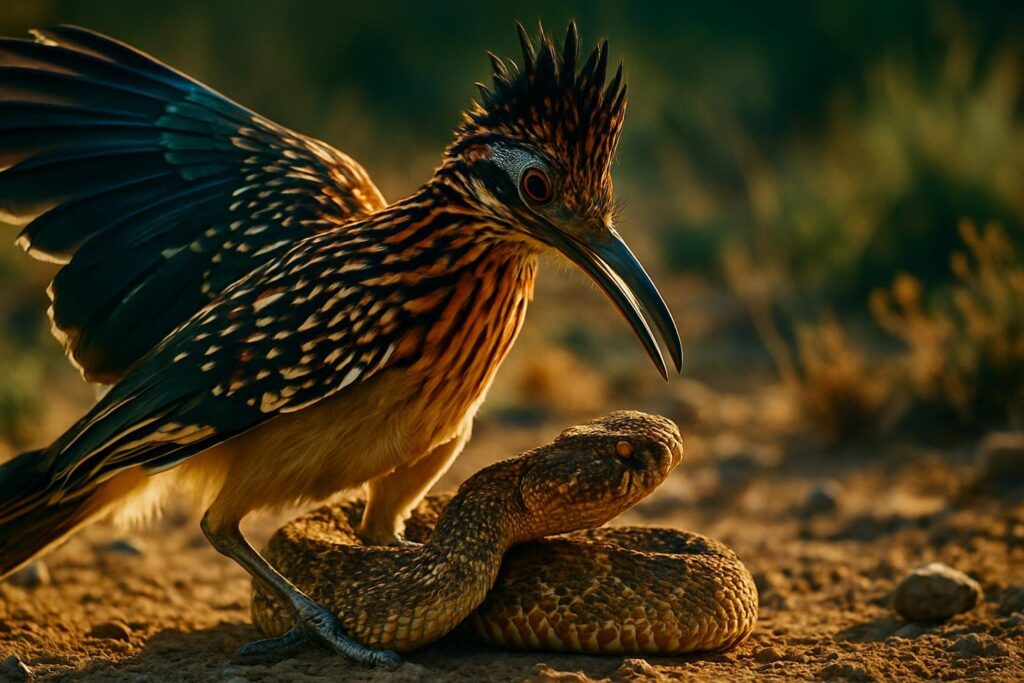
Two roadrunners. One distracts. The other pins the head and bashes the snake against rock. No venom resistance — just a division of labor that ends with a dead rattlesnake.
Greater Roadrunners (Geococcyx californianus) are documented predators of rattlesnakes, and they accomplish this with no known systemic venom immunity. That fact is startling on its own. Most animals that survive rattlesnake encounters carry biological armor — opossums produce neutralizing serum proteins, honey badgers have modified acetylcholine receptors. The roadrunner brings none of that to the encounter.
What it brings instead is a partner.
How the Cooperative Rattlesnake Hunt Actually Works
Cornell Lab of Ornithology’s All About Birds documents the sequence directly. One bird jumps and flaps in front of the snake, drawing its attention and holding it. The rattlesnake locks onto the distractor. That is the opening the second bird needs — it rushes in from the side, pins the head, and then bashes the snake against rock or ground until it stops moving.
There is no documented role-switching or complex mid-sequence choreography in the scientific literature. The division of labor is straightforward: one bird distracts, one bird attacks.
How Roadrunners Process and Swallow a Snake After the Kill
Once the snake is dead, the mechanical problem shifts to swallowing. When prey is too long to go down at once, a roadrunner simply walks around with a length of snake hanging from its bill, swallowing incrementally as digestion progresses. Rock-bashing isn’t only a killing technique — it also breaks down the prey and makes the body easier to consume whole.
What “No Venom Immunity” Actually Means for a Roadrunner
The absence of specific venom resistance puts everything on execution. Field guides note roadrunners eat scorpions and venomous lizards with no ill effect, suggesting some general toxin tolerance, but no molecular mechanism equivalent to opossum neutralizing proteins has been identified. The safest read from available sources: roadrunners rely on behavioral avoidance of the bite itself — pinning the head eliminates the delivery system before it can be used.
The rattlesnake never gets a clean strike. That is the entire strategy.
Forty years of watching desert wildlife, and the roadrunner still surprises. The snake spent millions of years perfecting the ambush. The roadrunner’s answer was to bring a second bird. Sometimes the simplest solution is also the one nobody saw coming.
Frequently Asked Questions
Do roadrunners have venom immunity like honey badgers?
No. There is no documented systemic immunity to rattlesnake venom in roadrunners. They rely on behavioral strategies — primarily pinning the head — to avoid being bitten.
How fast can a roadrunner run?
Top confirmed speed is 20 mph (32 km/h). A commonly cited figure of 27 mph is not supported by major ornithological sources.
Do roadrunners always hunt rattlesnakes in pairs?
Not always. Cornell documents solitary kills via head-pecking and rock-bashing, but cooperative two-bird hunts are also explicitly recorded, with one bird distracting and one attacking.
What do roadrunners do if a snake is too big to swallow?
They swallow it progressively — walking with a portion of the snake hanging from the bill while digestion makes room for the rest.