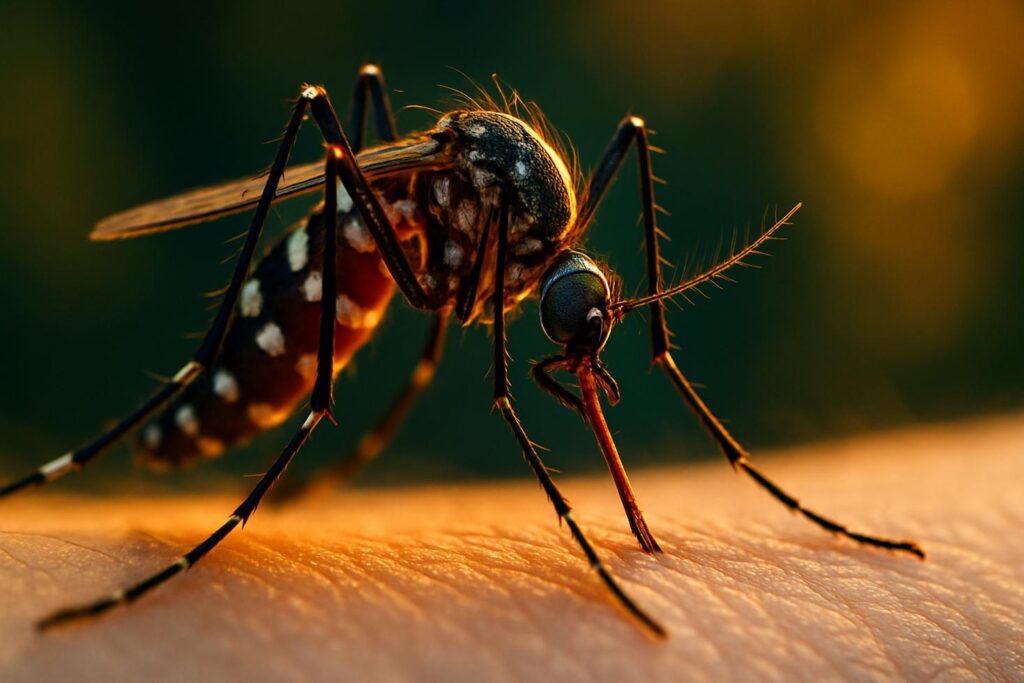
Type O secretors drew 83.3% relative landing rate in a 64-experiment test. Type A secretors drew 46.5%. No blood type dropped to zero.
Skin broadcasts a chemical identity, and mosquitoes can read it. In a 64-experiment human landing study on Aedes albopictus, type O secretors attracted mosquitoes at an 83.3% relative landing rate, compared to 46.5% for type A secretors — a roughly 2x gap measured under controlled conditions.
The signals doing that broadcasting are not coming from circulating blood. They are carbohydrate structures called ABH antigens, pushed outward through secretions from cells governed by the FUT2 gene. On secretors, those markers reach the skin surface. On non-secretors — roughly 20% of people — they don’t, and the landing gap between blood types largely disappears.
How ABH Antigens Reach the Skin Surface
The FUT2 gene controls whether ABO antigens appear in bodily secretions. Secretors express these carbohydrate markers in saliva, mucus, and sweat — fluids that reach the skin. When researchers in the Shirai study applied purified H antigen (associated with type O) and A antigen directly to participants’ arms, Ae. albopictus landed significantly more on H-treated skin than A-treated skin, and more on A than B. specific carbohydrate surface markers as mosquito-readable cues — that is the mechanism, not the blood itself.
Non-secretors carry a blood type genetically, but those markers never surface. Their skin offers no ABO-antigen signal, and mosquito landing rates between groups flatten out accordingly.
Why Blood Type Is Only One Layer of the Signal
Ae. albopictus is one species under one set of experimental conditions. Aedes aegypti studies have produced different rankings — one artificial-feeder study found peak feeding preference for blood type B, not O. Another found highest landing on O− donors. The O-is-best pattern is real but species-specific and assay-dependent.
A 2015 twin study found that roughly 67% of mosquito attraction variation is genetic — a figure comparable to heritability estimates for height. ABO genes and FUT2 are part of that genetic background, but so are genes affecting sweat composition, skin lipid profiles, and microbiome interactions. Carbon dioxide output, body heat, and skin microbiota metabolites remain the dominant long-range cues mosquitoes follow before they ever reach skin chemistry.
What the Data Actually Show About Type A
Type A secretors attracted half the landings of type O secretors in the Shirai study, but 46.5% is not zero. Mosquitoes still landed. No reviewed study found a blood type mosquitoes actively avoid or skip entirely. The effect is a statistical preference, not a shield.
The skin is not a barrier between body chemistry and the outside world. It’s an ongoing broadcast — blood type antigens layered on top of sweat volatiles, microbiota byproducts, and exhaled CO₂. Some broadcasts carry a stronger signal than others.
Frequently Asked Questions
Do mosquitoes actually prefer type O blood?
In the 2004 Ae. albopictus human landing study, type O secretors attracted significantly more mosquitoes than type A secretors. The effect is species-specific and not consistent across all experimental setups.
What is a secretor and why does it matter for mosquito attraction?
A secretor expresses ABO blood group antigens in bodily fluids and on skin surfaces, determined by the FUT2 gene. Non-secretors carry a blood type but don’t surface those markers, so blood type has little measurable effect on mosquito landing in that group.
Does blood type make someone immune to mosquito bites?
No. Every reviewed study confirms mosquitoes still land on individuals of all blood types. Type A attracted roughly half the landings of type O in one study — a real difference, not immunity.
Is blood type the main reason some people attract more mosquitoes?
No. A 2015 twin study attributed about 67% of variation in mosquito attraction to genetics broadly — including but not limited to blood type. Carbon dioxide, body heat, and skin microbiota volatiles are the dominant host-detection cues.