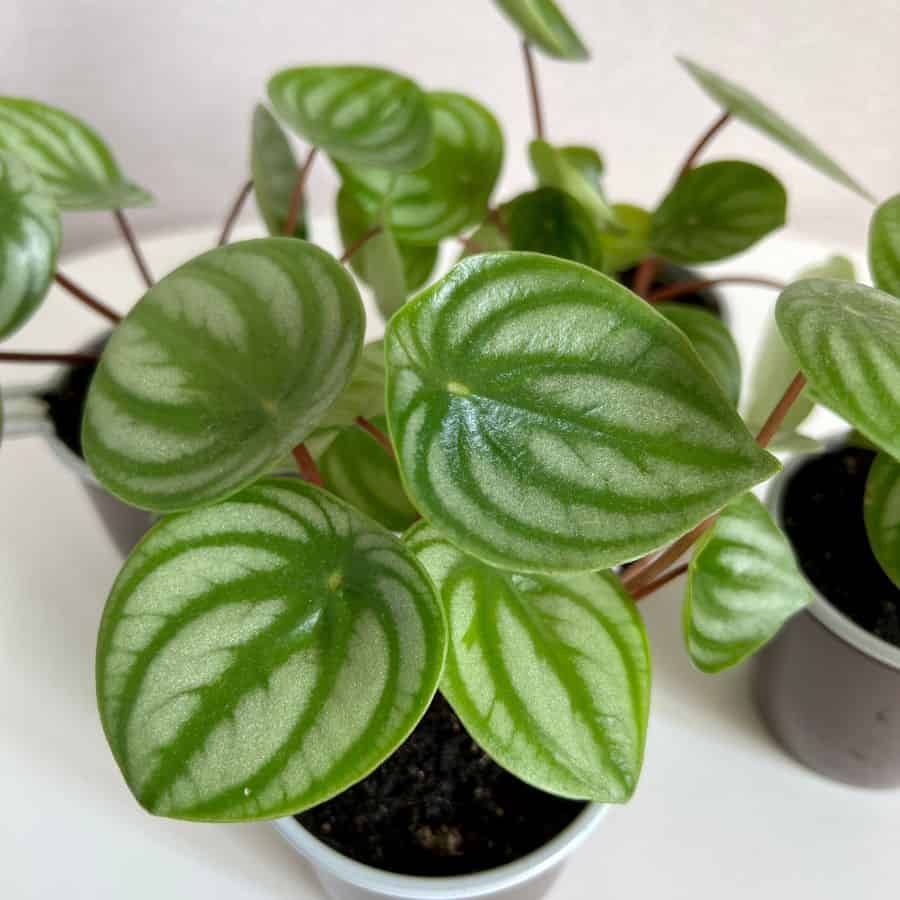
Peperomia plants are popular houseplants, and there are many different species to choose from. Some Peperomia species are succulent, while others are only semi-succulent.
All peperomia plants hail from South America. They are members of the pepper family.
Where Did the Name “Radiator Plant” Come From?
You may hear the peperomia plant referred to as the Radiator Plant. This name was given to it by American horticulturist Liberty Hyde Bailey, presumably because this type of plant likes to be kept in very warm, bright settings.
Although being kept on a radiator would be rather hot and dry, some peperomia plants prefer dry climates, while others prefer wet ones.

In truth, the different types of peperomia vary in many different ways. For example, some grow as bushes or in clusters, and others have a vining, trailing growth habit. Some produce woody growth while others grow from a central core.
Some types have small leaves, while others have very large ones. The foliage of these plants may be quite fleshy and easily recognizable as a succulent. Some have thick, shiny green leaves. Still others may have ridged, rippled, and/or variegated leaves.
All Peperomia plants produce extremely small, bisexual flowers that appear on tall, slender spikes, sometimes referred to as “mouse tails”. These interesting-looking spikes grow to be about a foot tall.
Peperomia Overview and Propagation
Light & Temperature
Peperomia like bright, indirect sunlight such as that found in a northern window. You can put this type of plant in a very sunny southern or western window, but it’s a good idea to put a light curtain over the window to help filter the sunlight.
In the wintertime, keep your peperomia plant in a warm room minimum 65 degrees Fahrenheit) and protect it from cold drafts. It should not be kept too close to a window or a door that opens and closes, as this allows cold air in.
Soil & Transplanting
Peperomia likes a light, airy, loamy soil. A combination of equal parts loam, peat moss, and coarse sand (alternately vermiculite or perlite) makes a perfect mix. You will seldom need to repot your peperomia because they are not fast growers.
Watering & Fertilizing
Feed once a month throughout the growing season. Use a standard, slow-release liquid houseplant fertilizer at half strength.
Propagation
Peperomia are easy to propagate using stem or leaf cuttings. If you do repot your plant, you can also propagate by division.
It may take quite a while for new roots to appear on cuttings, especially during the winter months. Cuttings taken and started in spring and summer will root more quickly.
Common Pest & Disease Problems
Peperomia that are overwatered or kept too crowded are subject to predation by spider mites and aphids.
Plants kept at temperatures below 60 to 65°F tend to lose their leaves.
As leaves mature, they will naturally yellow and should be removed. Simply pinch them off close to the main stem.
Excessive watering can cause root, stem, and leaf rot. If the flesh of the plant darkens, and the leaves yellow and then turn dark, suspect rot (a.k.a.: fungal infection).
When this happens, you must remove the plant from its pot and shake all the wet soil away from the roots.
Prune away any rotted portions, and allow the plant to dry in the open air for a few hours.
Repot in fresh, dry soil in a terra-cotta pot with proper drainage holes. Wait a week and then water moderately.
Plants that experience sudden chilling may develop anthracnose. The symptoms include black or dark tan, dry spots in the center of the leaves.
Leaves may also develop dark margins. Alternatively, you may see dark leaf tips with dark criss-crossing bars.
If this happens, you must remove and destroy the infected leaves. Add good ventilation to your growing area, but do not allow cold air in. Treat the surviving plant with a foliar fungicide.
Many different negative conditions, such as:
- Poor Air Circulation
- Excessive Humidity
- Overwatering
- Low Lighting
- Chilling
… can cause leaf spot disease. It manifests as blistered spots on the leaves in shades of yellow, brown, or black. The spots usually have yellow margins.

If this happens, you must determine the cause and optimize your growing area. Prune away all infected parts of the plant and spray the surviving leaves and stems with fungicide.
Best Uses for Peperomia
Peperomia are touted as effective at indoor air purification. In all climates, Peperomia make delightful houseplants.
Because there are so many species, it is easy to amass an impressive, seemingly eclectic collection of houseplants, all Peperomias.
This ends up being a very easy-care collection of hanging plants, succulents, windowsill, and tabletop plants, since all your houseplants will need the same care.